


resources
What Is Window Balance Tech and Why Cities Should Care
11 Jun 2026

There are innumerable windows that operate every day across the 5.9 million commercial buildings nationwide, and a failure of these hidden mechanisms directly threatens building efficiency. When a mechanical balance snaps or loses its tension, the window sash fails to seal tightly against the top or bottom meeting rails. The resulting air infiltration destroys the integrity of the building envelope, forcing central HVAC units to work overtime to compensate for constant drafts.
Window balance technology is the hidden mechanical system built into vertical sliding window frames that counteracts the sash's weight, allowing people to open, close, and hold windows open safely. Without functioning balances, a heavy window sash becomes a guillotine-style hazard or drops permanently into its frame, locking out ventilation and turning minor operational flaws into massive liabilities. In municipal property management and urban real estate portfolios, understanding these mechanisms changes how maintenance departments handle building envelopes, safety compliance, and rising energy costs.
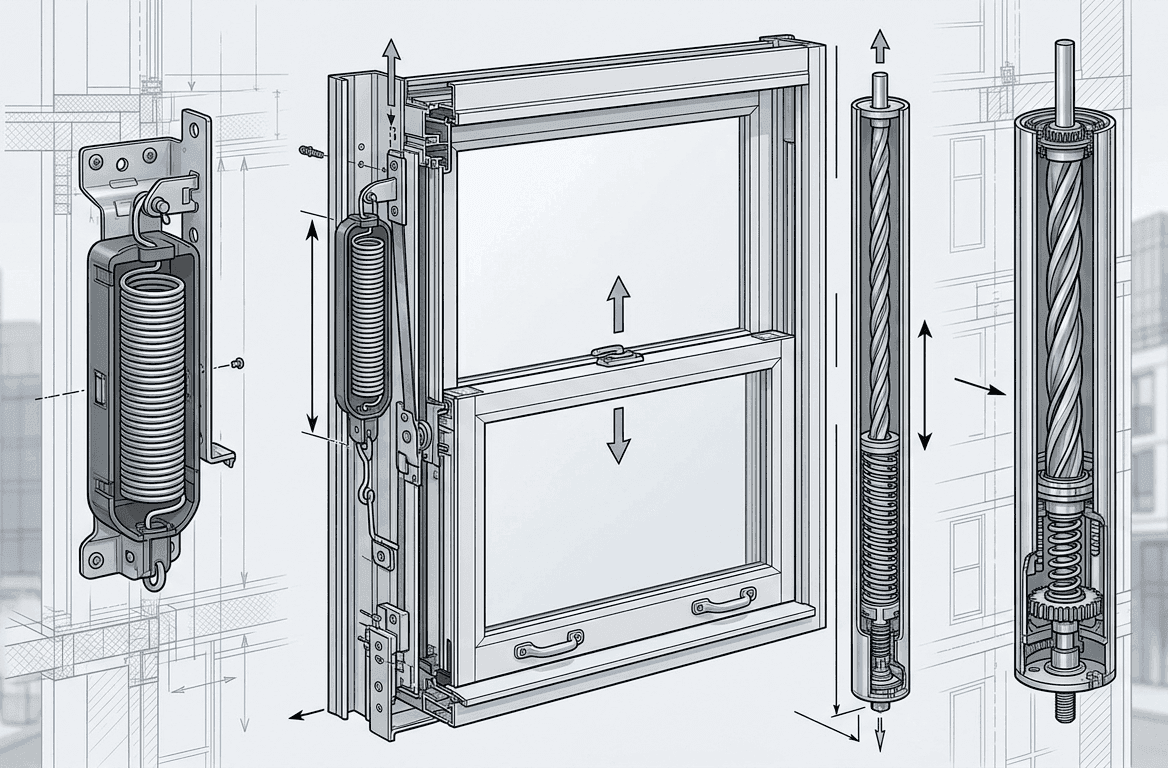
Mechanical Profiles of Coil and Spiral Systems
Modern building maintenance typically focuses on two primary balance variations to keep double and single-hung architectural windows operational. Spiral balances use a rod wrapped with a torsion spring inside a metal tube, allowing fine adjustments to tension to accommodate varying window weights over time.
Constant-force coil springs use heavy-duty stainless steel bands that uncoil smoothly as the window lowers, providing uniform assistance throughout the entire path of travel. Upgrading old, rusted block-and-tackle units with a heavy-duty replacement for a window spring allows property managers to restore effortless physical operation to heavy, double-insulated architectural glass units. Selecting the wrong spring capacity or matching an 8-lb coil spring to a 12-lb sash causes rapid mechanical degradation, leading to sagging frames and broken lock alignments.
Urban Infrastructure and Environmental Management Goals
Neglecting window hardware directly compromises corporate environmental, social, and governance targets, as well as local municipal green building mandates, all of which are important in an era of increased transparency. When window balances fail across a multi-story public housing complex or an administrative complex, the cumulative structural air leakage can skew regional energy consumption patterns.
Fixing these component failures protects infrastructure investments in several key areas:
- Structural safety compliance by eliminating falling sashes that damage property or cause occupant injuries
- Acoustic insulation by ensuring tight frame seals that block disruptive street-level traffic noise
- Interior moisture control by maintaining compressed weather stripping that keeps wind-driven rain out of wall cavities
Poorly maintained windows also restrict emergency ventilation options, creating localized indoor air quality crises during extreme heat events. The Lawrence Berkeley National Laboratory report highlights how targeted retrofits of existing window structures drastically cut nationwide commercial building energy loads. Municipalities that proactively address these basic mechanical and structural issues avoid the massive capital expenditure of a total window replacement while keeping buildings code-compliant.
Preserving Structural Security and Smooth Operation
A tight physical seal is the first line of defense against both external weather conditions and unauthorized entry. When a window sash sits crookedly due to a broken internal coil or an imbalanced spiral tension rod, the security latches will not align properly, leaving properties vulnerable to structural breaches.
Overworked maintenance crews often resort to using wooden blocks to wedge broken windows open or closed, which violates basic fire escape safety ordinances and compromises emergency egress paths. Ensuring that maintenance departments check balance tensions during routine building envelope reviews keeps operations running smoothly. Our site has many more posts on technical aspects of modern urban building design like this that matter most, so stick around and read more.


