
citiesabc, first_page
The Oldest Nations on Earth: A Journey Through Time's Survivors
25 Jun 2026

A Historical Analysis
Civilisation begins with order, grows with liberty and dies with chaos. — Will Durant
What if everything you were taught about power was incomplete?
We are told that history is the story of progress, a straight line from caves to cathedrals, from tribes to democracies, from ignorance to enlightenment. But look closer, and a more uncomfortable truth emerges: history is not a line. It is a spiral. The same patterns of rise, dominance, corruption, and collapse repeat themselves across millennia, wearing different clothes, speaking different languages, worshipping different gods but driven by the same fundamental hungers: for order, for meaning, for control.
Every empire that ever existed believed, with total sincerity, that it was the final answer. Rome thought it was eternal. The Mongols thought heaven itself had mandated their conquest. The British Empire draped its extraction of entire continents in the language of civilisation and duty. And yet, scattered across the modern map, a handful of nations have done something almost no empire managed: they survived. Not unchanged, not unscarred, but recognisably themselves, across conquest, occupation, genocide, and erasure attempts that would have wiped a lesser identity off the earth entirely.
This is not merely a catalogue of dates and dynasties. It is an investigation into civilisational endurance, into what it actually takes for a people to remain a people across thousands of years, when every incentive of history points toward dissolution. Drawing upon multiple levels of research and academic and my passion to map humanity's history, past, present, and future and looking at publications and research from authors such as Yuval Noah Harari's Sapiens, Ian Morris's Why the West Rules For Now, and the work of historians specialising in each civilisation examined here, this article outlines a historical analysis of the world's oldest nations: the methods by which they survived, the controversies that surround their claims, and what their longevity tells us about the nature of identity itself.
Because to understand why a nation outlives its empires is to understand something essential about what holds a people together and what doesn't.
What Does "Oldest Nation" Even Mean?
"Oldest nation" is one of history's most contested claims, and it deserves to be interrogated before any ranking is offered.
The distinction hinges entirely on how we define nationhood:
- Continuous statehood — an unbroken chain of sovereign governance over the same territory
- Ethnic and cultural continuity — a people who remain recognisably themselves regardless of who rules them
- Unbroken political identity — a self-conception that survives even total loss of sovereignty
- Longest inhabited territory — simple continuous human presence, regardless of political organisation
Each of these frameworks produces a completely different list. A nation can score brilliantly on cultural continuity while having lost statehood dozens of times (Armenia, Georgia). A nation can have an unbroken state apparatus while its founding ethnic and religious identity has been entirely replaced (Egypt). And a nation can have the most continuous monarchy on earth while resting on a foundational myth that historians openly acknowledge is fiction (Japan).
What follows is the most rigorously argued ranking, built by weighing these frameworks against each other, with the competing claims and scholarly disputes left in, rather than smoothed over for the sake of a cleaner story.
The Top 10 World's Oldest Nations
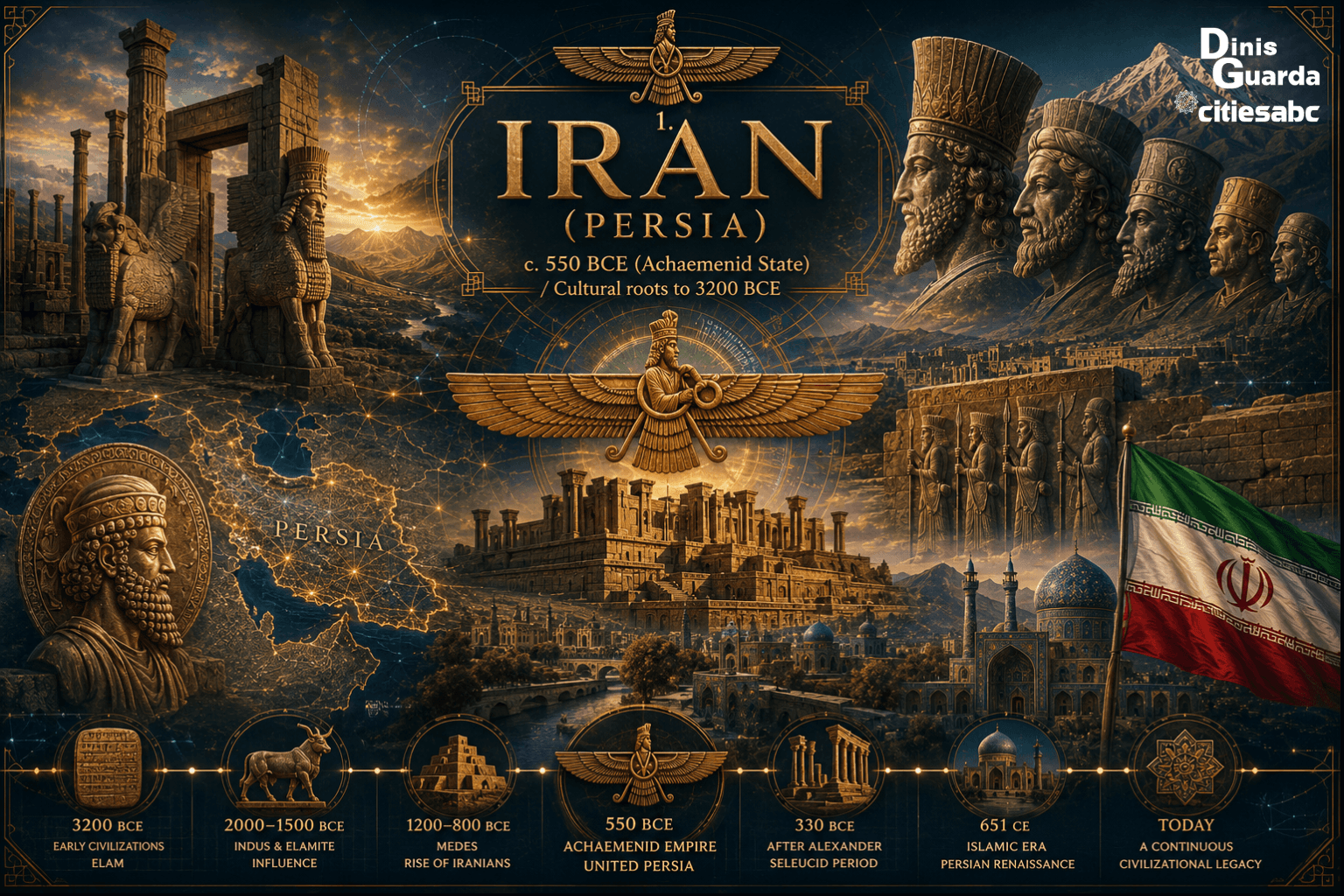
1. 🇮🇷 Iran (Persia) — c. 550 BCE (Achaemenid State) / Cultural roots to 3200 BCE
The claim: Iran is most credibly the world's oldest continuous nation-state. The Achaemenid Empire under Cyrus the Great (550 BCE) established a recognisable Persian political identity that has, despite conquest by Alexander, the Arabs, the Mongols, and the Ottomans, never fully dissolved.
The evidence: The concept of "Iran" as a distinct civilisational identity predates Islam by over a millennium. Even after the Arab conquest of 651 CE, Persian language, culture, and administrative structures reasserted themselves within a century, producing the "Persian Renaissance" of the 9th–10th centuries. Historian Richard Frye argued that Persian identity has the strongest case for unbroken civilisational continuity of any nation on earth.
The controversy: Strict statist historians argue that the multiple dynastic collapses and foreign conquests mean there is no single unbroken state — only a recurring cultural rebirth. The counter-argument is that no other civilisation has been conquered so many times and absorbed its conquerors so completely.
Iran is not a country that has a history; it is a history that has a country. — attributed to various Persian scholars
Why it tops the list: Persia's case is unique because it survived by cultural absorption rather than military invincibility. Every conqueror who took Persia eventually became Persianised, the Arabs adopted Persian administrative systems, the Mongols ruled through Persian bureaucrats, and the Turks built their imperial courts on Persian models. Few civilisations have demonstrated that kind of gravitational pull on their own conquerors.
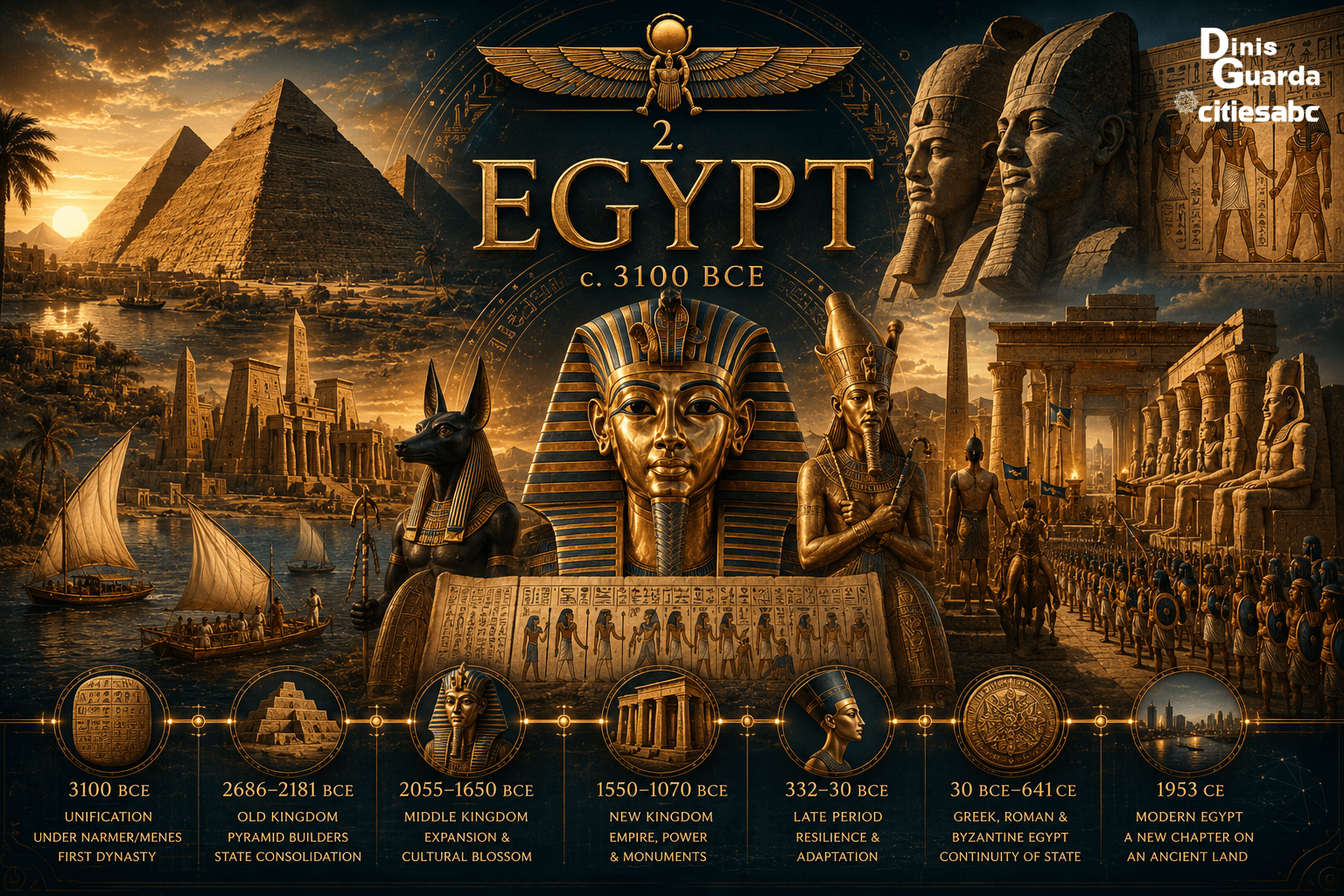
2. 🇪🇬 Egypt — c. 3100 BCE
The claim: Egypt is arguably the most architecturally and institutionally documented ancient state in history. Unified under Narmer/Menes around 3100 BCE, it maintained recognisable statehood for nearly 3,000 continuous years, longer than any other polity in recorded history.
The evidence: The Egyptian state maintained consistent administrative, religious, and cultural frameworks across 30 dynasties. No other civilisation ran a recognisably continuous state for three millennia. The very concept of a "nation" with centralised government, taxation, a standing army, and a bureaucracy arguably originates here.
The controversy: Modern Egypt is the Arab Republic of Egypt, founded in its current form in 1953. The ancient Egyptians were not Arabs, did not speak Arabic, and practised a religion now extinct. The claim to continuity is therefore largely geographic, the Nile has always been there; the "Egyptians" have changed dramatically.
The paradox at the heart of Egypt's claim: This is perhaps the clearest case where statehood continuity and identity continuity pull in opposite directions. If you measure by territory and the idea of a unified Nile state, Egypt is unmatched. If you measure by ethnic, linguistic, and religious continuity, modern Egypt is a near-total replacement of the civilisation that built the pyramids.
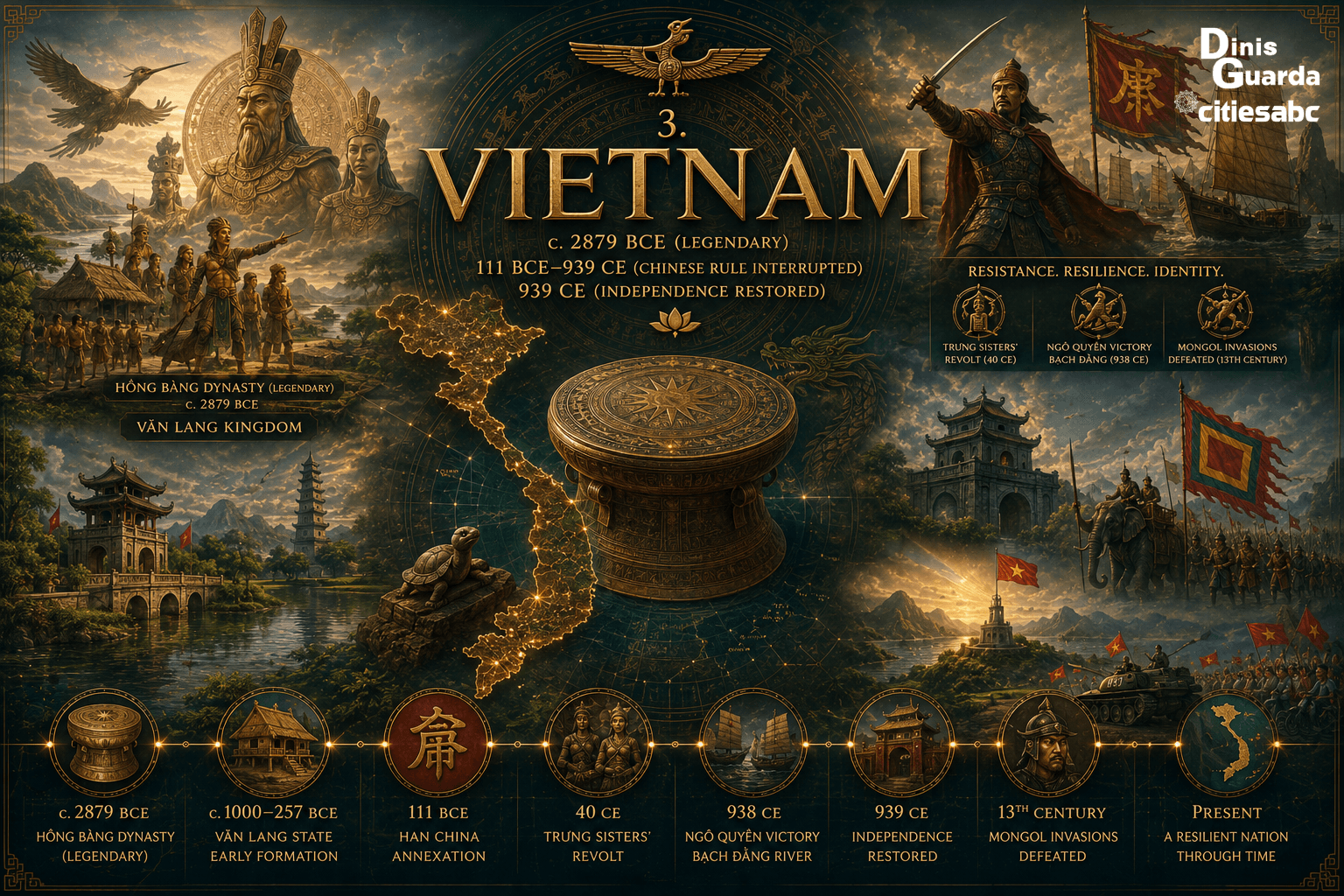
3. 🇻🇳 Vietnam — c. 2879 BCE (legendary) / 111 BCE–939 CE (Chinese rule interrupted) / 939 CE (independence restored)
The claim: Vietnam's claim to antiquity is anchored in the legendary Hồng Bàng dynasty (c. 2879 BCE) and the Văn Lang kingdom – the earliest recorded Vietnamese state. More critically, Vietnam is one of the rare nations that survived over a thousand years of Chinese occupation and still emerged with a distinct language, identity, and culture intact.
The evidence: Vietnamese resistance to Chinese domination is one of the defining threads of East Asian history. The Trưng Sisters' revolt (40 CE), Ngô Quyền's decisive victory at the Bạch Đằng River (938 CE), and the subsequent repulsion of Mongol invasions in the 13th century demonstrate a national resilience that historians like Keith Weller Taylor describe as remarkable for its consistency and ferocity. The Vietnamese language — despite a millennium of Chinese administrative pressure — survived and flourished.
The controversy: The legendary founding dates are mythological and not archaeologically verified. The Đại Việt kingdom (968 CE onwards) is the more defensible starting point for continuous Vietnamese statehood. The division of North and South Vietnam (1954–1975) also complicates claims of unbroken continuity.
The defining trait: Vietnam's case is built almost entirely on resistance as identity. Few nations have spent so much of their history actively, repeatedly fighting off the world's largest neighbouring power and still come out the other side linguistically and culturally distinct.
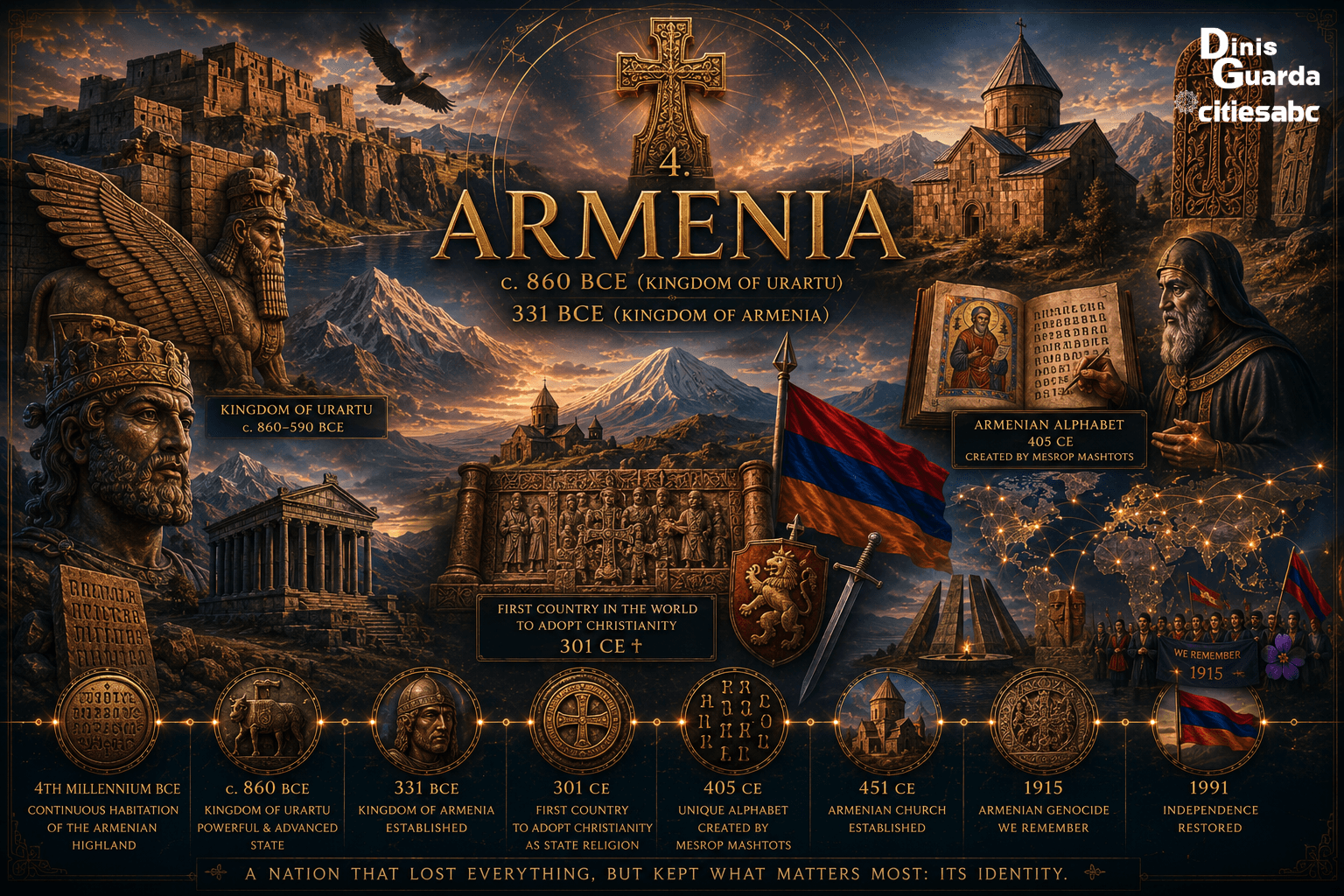
4. 🇦🇲 Armenia — c. 860 BCE (Kingdom of Urartu) / 331 BCE (Kingdom of Armenia)
The claim: Armenia is one of the world's oldest nations with a continuously documented ethnic and cultural identity. It was the first country in the world to adopt Christianity as its state religion, in 301 CE — a defining act that has anchored Armenian national identity across millennia of invasion, genocide, and diaspora.
The evidence: The Armenian Highland has been continuously inhabited since at least the 4th millennium BCE. The Kingdom of Urartu (860–590 BCE), centered on Lake Van, is recognised by most historians as the direct precursor to the Armenian state. Armenia's adoption of a unique alphabet (405 CE, created by Mesrop Mashtots) further cemented a cultural identity so durable it survived the Ottoman Genocide of 1915, Soviet rule, and the diaspora scattering Armenians across five continents.
The controversy: Armenia lost statehood repeatedly — absorbed by Rome, Persia, the Arabs, the Mongols, the Ottomans, and the Soviets. Modern Armenia (independent since 1991) is technically one of the newer republics of the former Soviet Union. The continuity is therefore deeply cultural rather than political — but by that measure, Armenia's claim is among the strongest in the world.
The hardest case for survival: Armenia may represent the single most extreme test case of civilisational endurance on this list. A nation that lost its land, suffered genocide, and was scattered across the globe — and still maintained a language, alphabet, church, and identity coherent enough to reconstitute a state in 1991. If identity can survive that, the question of what makes a nation "old" becomes less about borders and more about will.
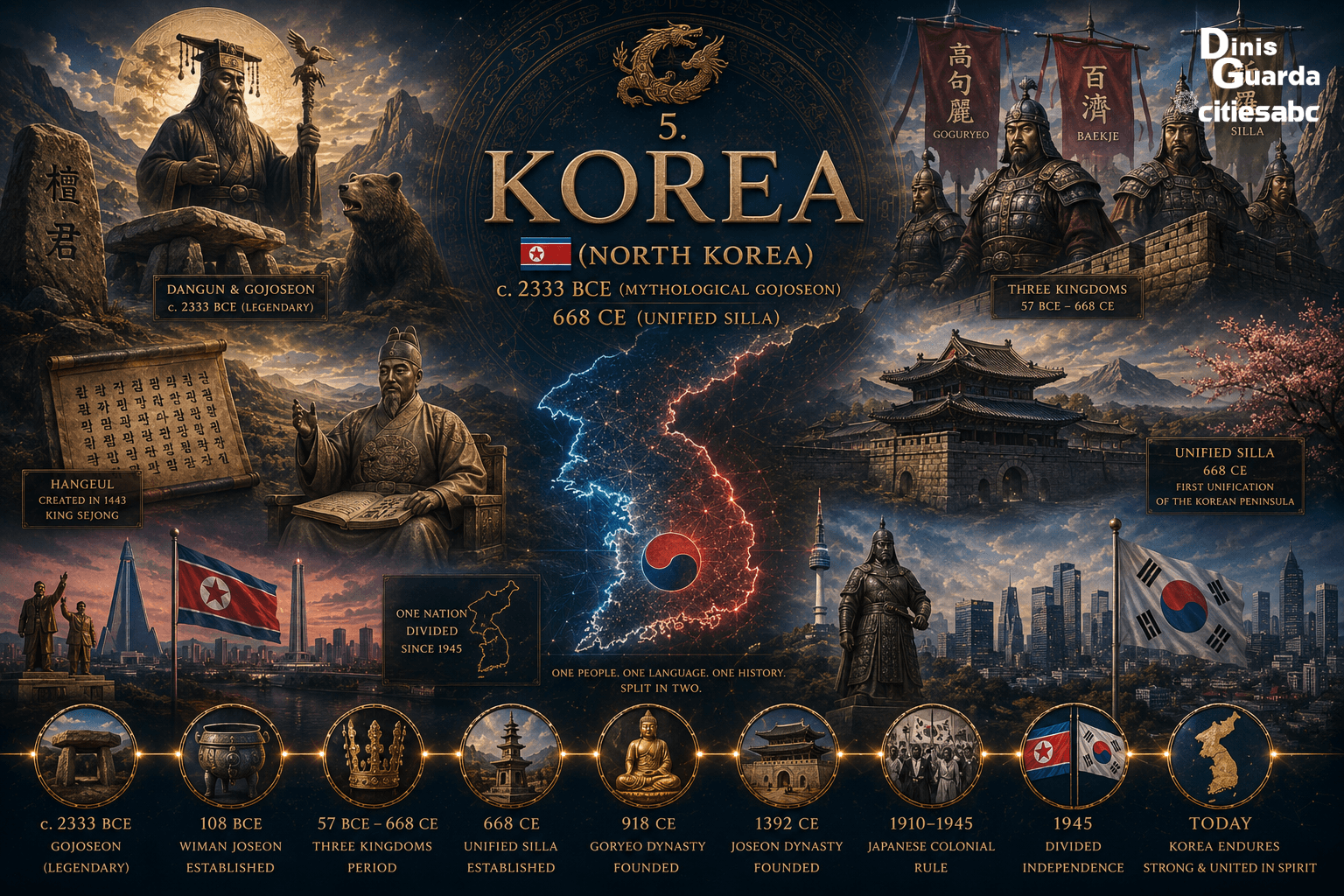
5. 🇰🇵 North Korea (Korea) — c. 2333 BCE (mythological Gojoseon) / 668 CE (Unified Silla)
The claim: Korea has one of the most remarkably preserved ethnic and linguistic identities in the world. Despite centuries of Chinese influence, Mongol invasion, and Japanese colonisation, Korean language, culture, and a distinct sense of national identity have endured for millennia.
The evidence: The Korean language is a language isolate, unrelated to Chinese or Japanese and has been spoken continuously for thousands of years. Korea's ethnic homogeneity and geographic containment on a peninsula created one of the most coherent national identities in Asia. Both North and South Korea claim descent from the ancient Joseon and Three Kingdoms periods, making Korean civilisational continuity one of the most robustly evidenced in East Asia.
The controversy: The mythological founding by Dangun in 2333 BCE is not historically verifiable. The first confirmed Korean state is typically the Three Kingdoms period (57 BCE–668 CE). The current division between North and South Korea since 1945 is the central modern complication, both states claim to be the legitimate heir of the Korean nation, making "Korea" simultaneously one of the oldest civilisations and one of the most politically fractured modern cases.
A nation split in two, claimed by both halves: Korea is the strangest entry on this list precisely because its "oldest nation" status is now a geopolitical weapon. Pyongyang and Seoul both invoke Gojoseon and Silla as their own inheritance, meaning the question of Korean antiquity is no longer purely historical; it is actively contested in the present tense.
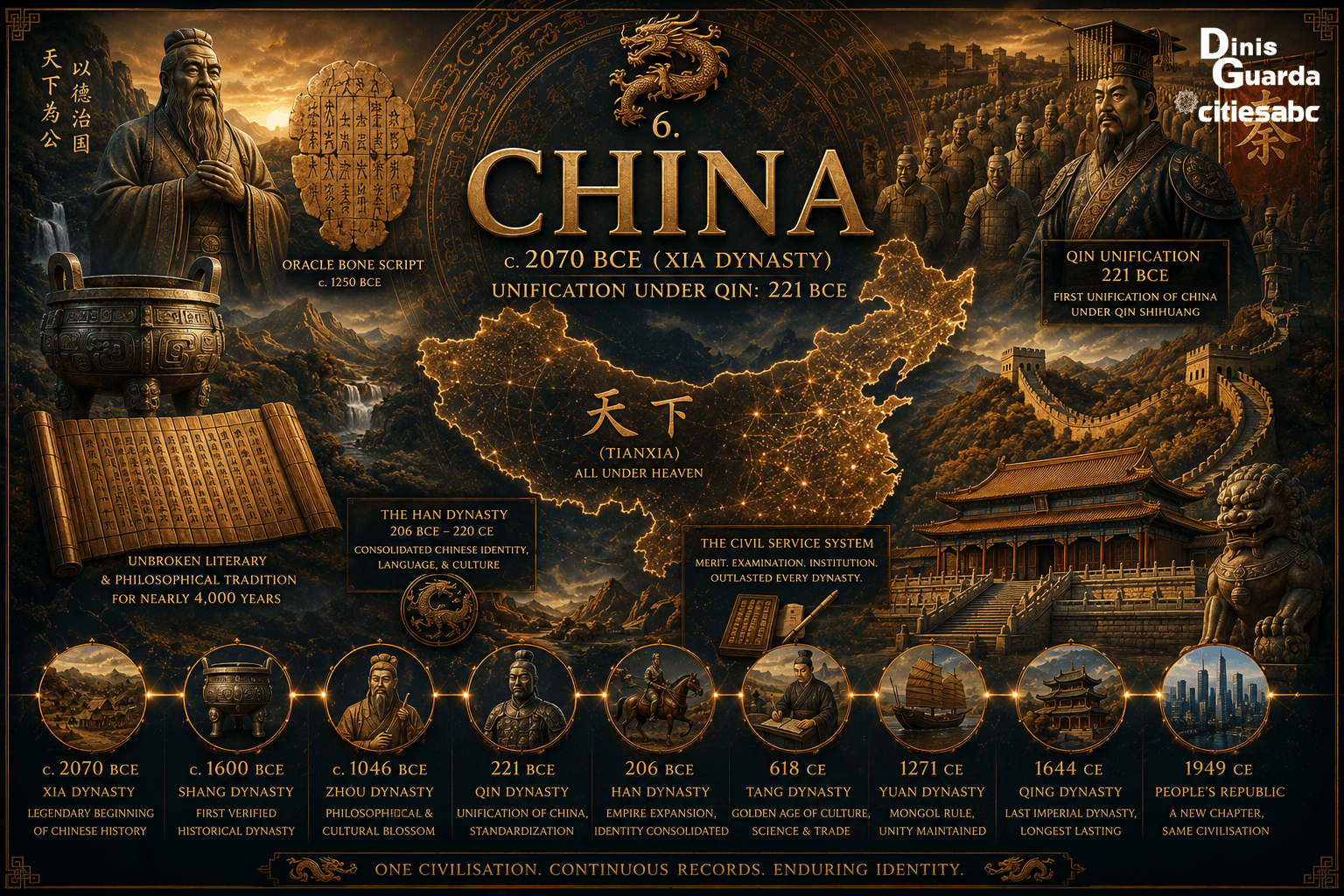
6. 🇨🇳 China — c. 2070 BCE (Xia Dynasty) / Unification under Qin: 221 BCE
The claim: China presents the most compelling case for the longest continuous civilisation, with oracle bone script, continuous dynastic records, and an unbroken literary and philosophical tradition stretching nearly 4,000 years.
The evidence: The concept of "Tianxia" (天下, "All Under Heaven"), a unified Chinese political and moral order, has persisted across radical dynastic change. The Han Dynasty (206 BCE) consolidated an ethnic and cultural identity so durable that the majority ethnic group still bears its name. Historian John Keay notes that China's bureaucratic continuity across dynasties is "without parallel in human history."
The controversy: Critics point out that modern China is technically the People's Republic, founded in 1949 — making it younger than Germany. The deeper issue is whether the CCP represents continuity with, or a rupture from, Imperial China. Additionally, the Xia Dynasty's historicity remains debated; Western scholarship often anchors verified Chinese history to the Shang Dynasty (c. 1600 BCE).
The bureaucratic secret: China's longevity is arguably less about emperors and more about institutions. The civil service examination system, the written script, and the philosophical infrastructure of Confucianism all outlasted every dynasty that ever ruled through them, suggesting the real "nation" was always the system, not the ruling family sitting on top of it.
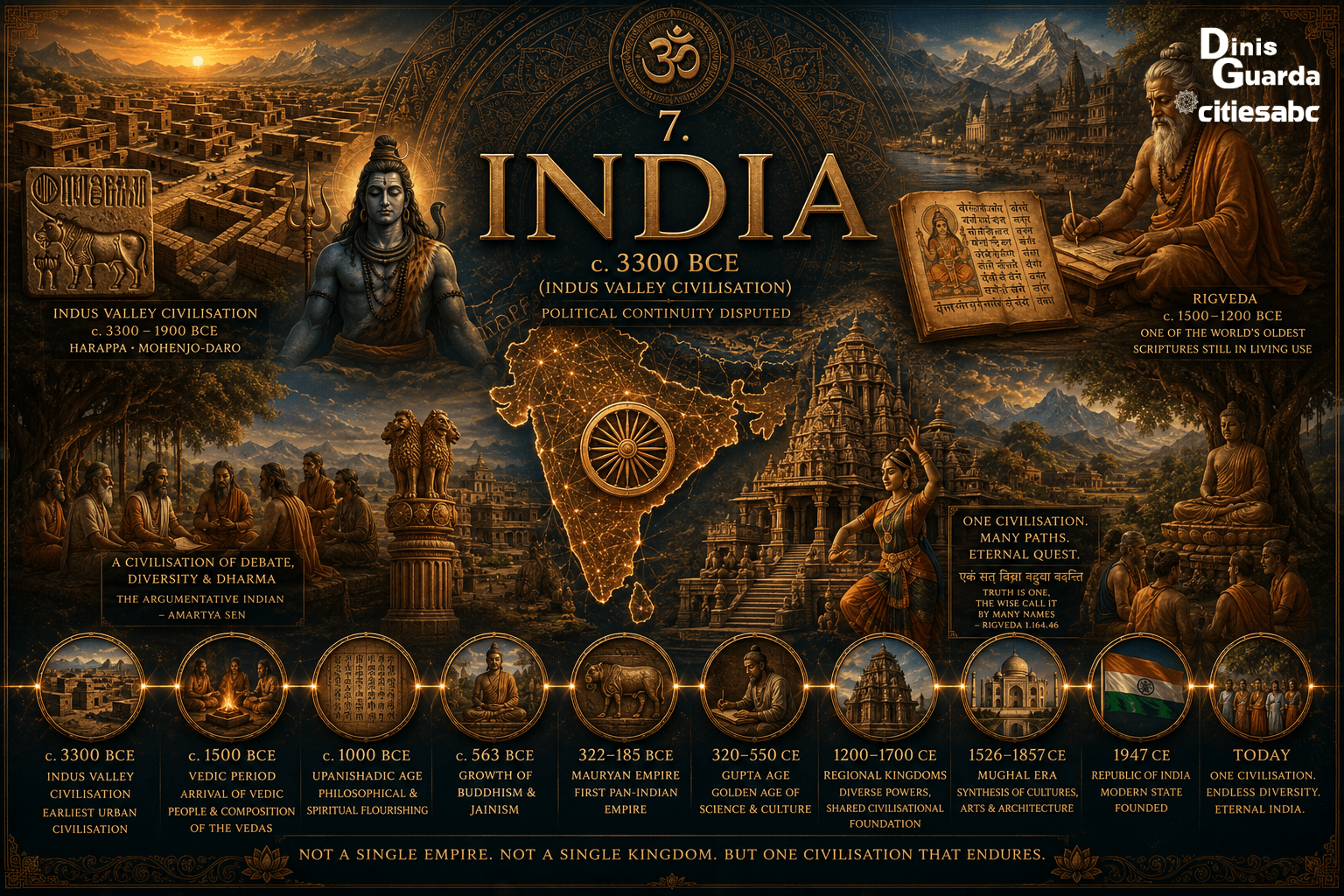
7. 🇮🇳 India — c. 3300 BCE (Indus Valley) / Political continuity disputed
The claim: India's civilisational roots are among the deepest on earth. The Indus Valley Civilisation (Harappa and Mohenjo-daro) predates both classical Greece and Rome, and the subcontinent has maintained a recognisable cultural and spiritual identity, Hinduism, Sanskrit, the Vedic tradition, for over 3,500 years.
The evidence: The Rigveda (c. 1500–1200 BCE) is one of the oldest religious texts still actively used in living practice. No other civilisation can claim a scripture of such antiquity that remains liturgically alive. Amartya Sen, in The Argumentative Indian, argues that India's "national" identity is not political but civilisational, rooted in plurality, debate, and a continuity of ideas rather than borders.
The controversy: The Republic of India was founded in 1947. Whether modern India constitutes a continuation of the Mauryan Empire, the Mughal Empire, or is an entirely new political entity is deeply contested. The Indus Valley Civilisation collapsed around 1900 BCE and its relationship to later Vedic culture remains one of archaeology's great unsolved debates.
A civilisation, not a state: India's claim only makes sense if you abandon the idea of nationhood as political unity altogether. India was almost never a single unified polity for most of its history, it was a constellation of kingdoms, empires, and regional powers that nonetheless shared a deep enough religious and philosophical substrate to be recognised, by themselves and others, as one civilisational entity.
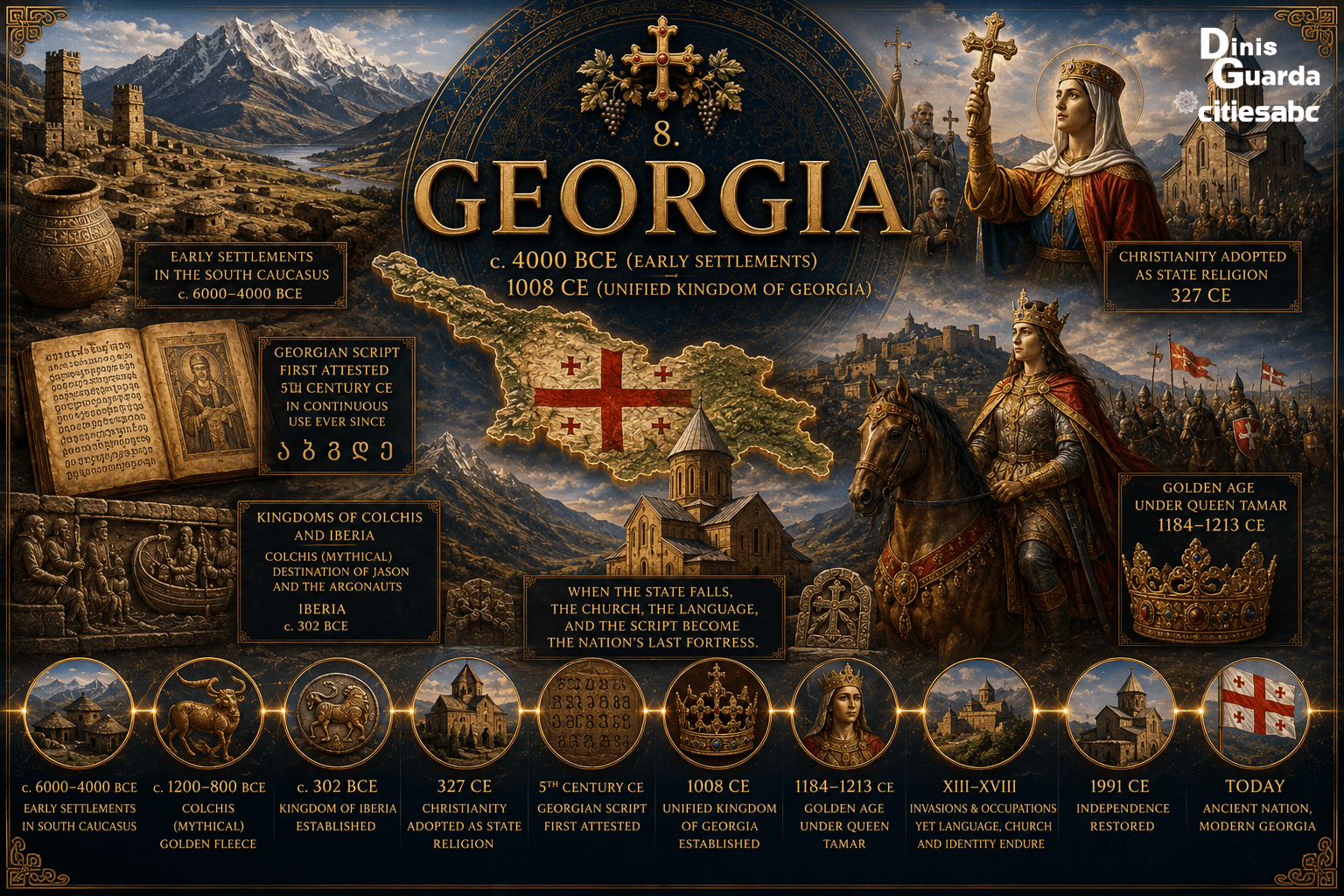
8. 🇬🇪 Georgia — c. 4000 BCE (early settlements) / 1008 CE (unified Kingdom of Georgia)
The claim: Georgia is one of the world's oldest continuously inhabited regions and one of the earliest Christian nations, adopting Christianity as its state religion in 327 CE, predating most of Europe. The Georgian language and its unique script (one of only 14 original scripts in the world) are among the clearest markers of an ancient, unbroken identity.
The evidence: Archaeological evidence places advanced human settlement in the South Caucasus region as far back as 6000–4000 BCE. The Kingdom of Colchis (referenced in Greek mythology as the destination of Jason and the Argonauts) and the Kingdom of Iberia (c. 302 BCE) are the earliest documented Georgian polities. The unified Georgian kingdom reached its Golden Age under Queen Tamar (1184–1213 CE), becoming the dominant power in the Caucasus. Georgian script, first attested in the 5th century CE, has remained in continuous use ever since.
The controversy: Like Armenia, Georgia lost formal statehood repeatedly, to the Mongols, Persians, Ottomans, Russians, and Soviets. Modern Georgia re-gained independence in 1991. The continuity is therefore cultural and linguistic rather than unbroken political but the survival of a unique language, script, and Christian identity through centuries of occupation makes Georgia's case compelling.
The Caucasus pattern: Georgia and Armenia, geographically squeezed between every major empire of the last three thousand years, show a strikingly similar survival mechanism: when the state falls, the church, the language, and the script become the nation's last fortress. Both nations prove that statehood is replaceable in a way that a living, written language is not.
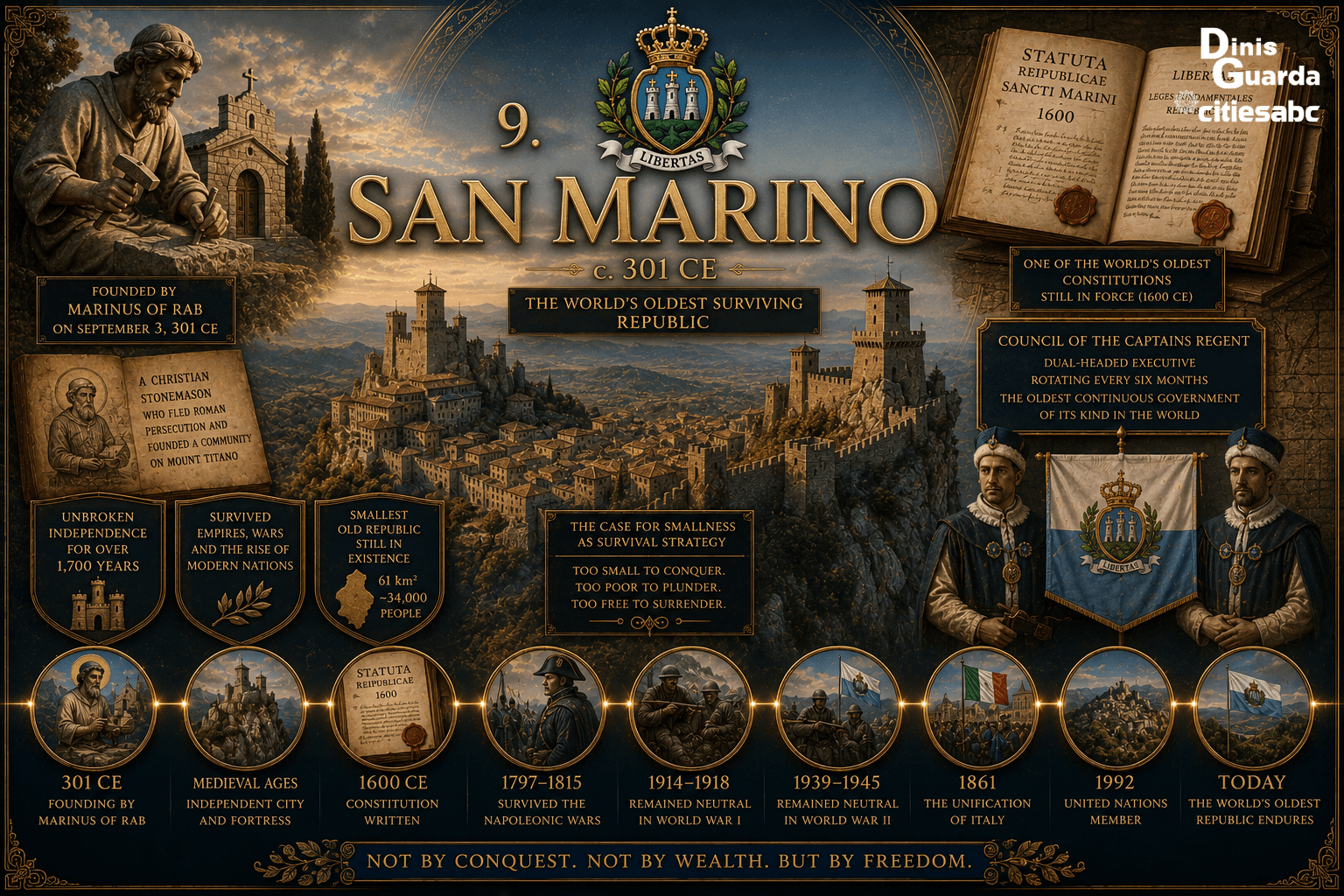
9. 🇸🇲 San Marino — c. 301 CE
The claim: San Marino holds the Guinness World Record as the world's oldest surviving republic, founded on September 3, 301 CE by a Christian stonemason named Marinus of Rab, who fled Roman persecution. Remarkably, this small landlocked enclave within Italy has maintained its independence and republican government continuously for over 1,700 years.
The evidence: San Marino's constitution, dating in part to 1600 CE, is one of the world's oldest written constitutional documents still in force. The country survived the Napoleonic Wars, two World Wars, the unification of Italy, and the entire rise and fall of the modern nation-state system, without ever being permanently absorbed. Its Council of the Captains Regent, a dual-headed executive rotating every six months, is the oldest continuous governmental institution of its kind in the world.
The controversy: San Marino is a microstate of just 61 km² and roughly 34,000 people. Critics argue that its "continuity" was enabled by geographic obscurity and the strategic indifference of larger powers, rather than genuine political resilience. Its significance as a "nation" is also questioned given its size but by strict criteria of unbroken republican governance, no other country comes close.
The case for smallness as survival strategy: San Marino's secret may not be resilience at all, but irrelevance, it was simply never worth the cost of conquering. That is itself a lesson in imperial history: sometimes the safest place to stand is somewhere too small and too poor to be worth anyone's ambition.
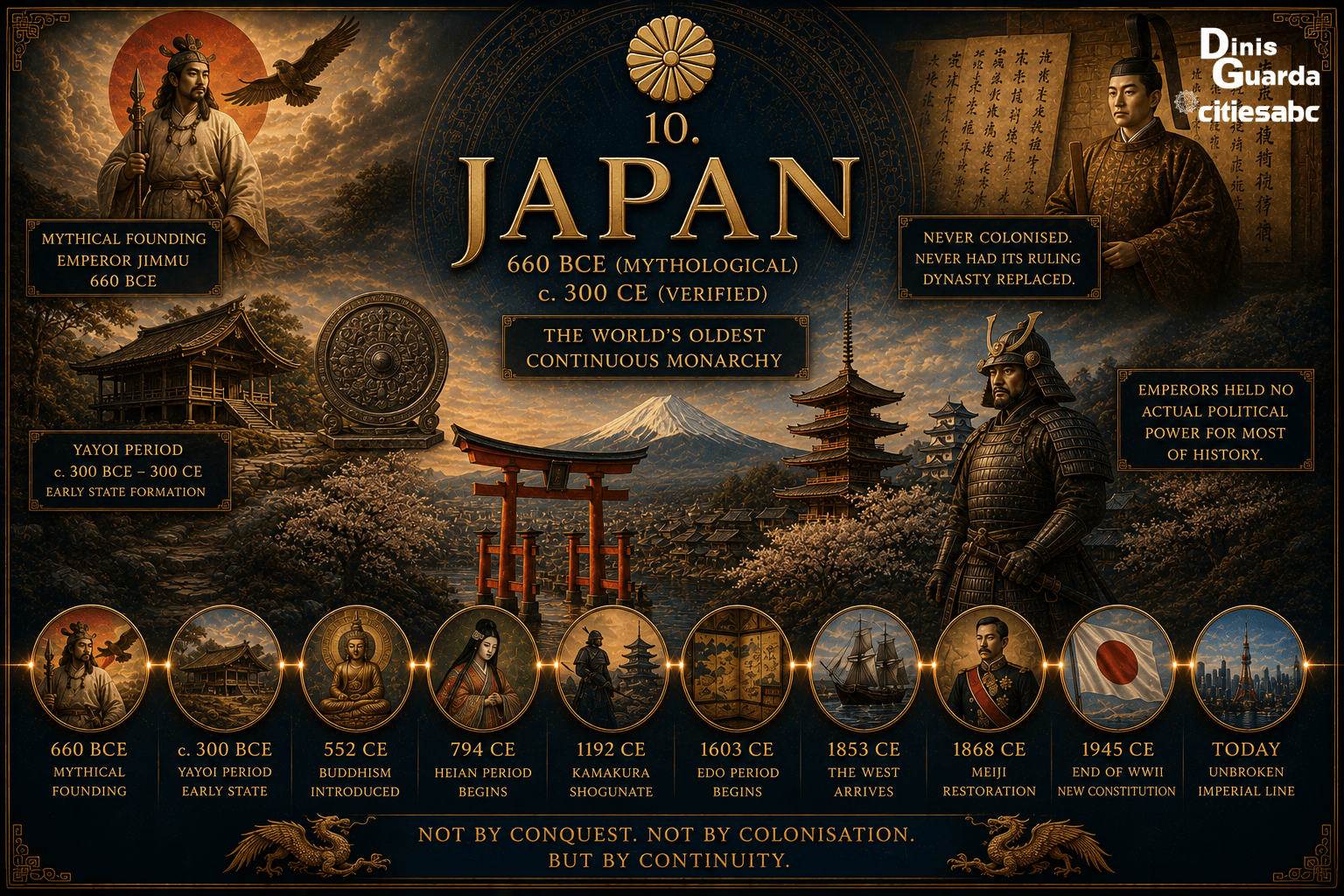
10. 🇯🇵 Japan — 660 BCE (mythological) / c. 300 CE (verified)
The claim: Japan is the world's oldest continuous monarchy. The Imperial House of Japan holds the Guinness World Record for the longest-reigning royal family, with an unbroken line stretching by tradition to 660 BCE and by verifiable history to at least 300–500 CE.
The evidence: Japan was never colonised, never had its ruling dynasty replaced by a foreign power, and maintained an unbroken imperial institution even when emperors held no actual political power. This institutional continuity gave Japan an extraordinary capacity for national reinvention, absorbing Chinese culture, then Western modernity, without losing its core identity.
The controversy: The traditional founding date of 660 BCE (Emperor Jimmu) is mythological. The first historically verified emperor is typically dated to the 3rd–4th century CE. The Meiji Restoration of 1868 also represented such a radical political rupture that some historians argue it constitutes a new state built on old symbols.
The power of a symbol, not a sword: Japan's emperors spent most of Japanese history with little or no actual political power, real authority sat with shoguns, regents, and military governments. And yet the imperial line was never deposed. This suggests something counterintuitive: that a purely symbolic institution, stripped of power but never of legitimacy, can be one of the most durable things a nation can hold onto.
What These Ten Nations Actually Teach Us
Looking at these ten cases side by side, a pattern emerges that cuts against the standard imperial narrative this larger project usually examines.
Empires fall because of military overreach, economic collapse, or internal corruption — the very themes of decline explored elsewhere in this analysis. But nations, as opposed to empires, seem to survive through entirely different mechanisms:
- Language as the last fortress — Armenia, Georgia, Korea, and Vietnam all lost statehood repeatedly, yet their languages outlived every occupier.
- Symbolic continuity over political power — Japan's imperial line survived precisely because it stopped mattering politically; it became too symbolically important to abolish.
- Cultural absorption of the conqueror — Persia didn't survive by defeating its invaders; it survived by Persianizing them.
- Smallness as camouflage — San Marino's survival is arguably a story about being too small to bother conquering.
- Civilisational identity over territorial unity — India and China both prove that "nationhood" can persist for millennia without ever requiring a single unbroken political structure.
The age of a nation, in other words, is not a record of unbroken strength. It is far more often a record of what a people decided was non-negotiable when everything else, land, sovereignty, even survival itself, was taken from them.
The oldest nations on earth are not the ones that were never conquered. They are the ones that refused to disappear even after they were.
References & Sources
On Iran & Persia
- Frye, R. N. (2005). Iran. Mazda Publishers. — https://www.mazda-publishers.com
- Axworthy, M. (2007). Iran: Empire of the Mind. Penguin. — https://www.penguin.co.uk/books/56856/iran-by-axworthy-michael/9780141027937
On Egypt
- Shaw, I. (2000). The Oxford History of Ancient Egypt. Oxford University Press. — https://global.oup.com/academic/product/the-oxford-history-of-ancient-egypt-9780192804587
- Romer, J. (2012). A History of Ancient Egypt. Thomas Dunne Books. — https://us.macmillan.com/books/9780312622978/ahistoryofancientegypt
On Vietnam
- Taylor, K. W. (1983). The Birth of Vietnam. University of California Press. — https://www.ucpress.edu/book/9780520074170/the-birth-of-vietnam
- Kiernan, B. (2017). Viet Nam: A History from Earliest Times to the Present. Oxford University Press. — https://global.oup.com/academic/product/viet-nam-9780190053796
On Armenia
- Hovannisian, R. G. (1997). The Armenian People from Ancient to Modern Times. St. Martin's Press. — https://link.springer.com/book/9780312101688
- Lang, D. M. (1980). Armenia: Cradle of Civilization. Allen & Unwin. — https://www.worldcat.org/title/armenia-cradle-of-civilization/oclc/5963623
On Korea
- Cumings, B. (2005). Korea's Place in the Sun. W.W. Norton. — https://wwnorton.com/books/9780393327021
- Lee, K. (1984). A New History of Korea. Harvard University Press. — https://www.hup.harvard.edu/books/9780674615762
On China
- Keay, J. (2008). China: A History. HarperCollins. — https://www.harpercollins.com/products/china-john-keay
- Keightley, D. (1999). "The Shang." Cambridge History of Ancient China. Cambridge University Press. — https://www.cambridge.org/core/books/cambridge-history-of-ancient-china
On India
- Sen, A. (2005). The Argumentative Indian. Penguin. — https://www.penguin.co.uk/books/56679/the-argumentative-indian-by-sen-amartya/9780141012711
- Kenoyer, J. M. (1998). Ancient Cities of the Indus Valley Civilization. Oxford University Press. — https://global.oup.com/academic/product/ancient-cities-of-the-indus-valley-civilization-9780195779400
On Georgia
- Rapp, S. H. (2003). Studies in Medieval Georgian Historiography. Peeters Publishers. — https://www.peeters-leuven.be/detail.php?search_key=9789042913189
- Rayfield, D. (2012). Edge of Empires: A History of Georgia. Reaktion Books. — https://www.reaktionbooks.co.uk/display.asp?ISBNs=9781780230306
On San Marino
- Carrick, N. (1978). San Marino. Chelsea House Publishers. — https://www.worldcat.org/title/san-marino/oclc/3575064
- San Marino Official Government Portal. History of the Republic. — https://www.gov.sm/pub1/govSM/en/istituzione/storia.html
On Japan
- Totman, C. (2000). A History of Japan. Blackwell. — https://www.wiley.com/en-us/A+History+of+Japan-p-9781405123594
- van Wolferen, K. (1989). The Enigma of Japanese Power. Macmillan. — https://www.karelvwolferen.com
General & Comparative Works
- Harari, Y. N. (2014). Sapiens: A Brief History of Humankind. Harper. — https://www.ynharari.com/book/sapiens-2/
- Morris, I. (2010). Why the West Rules — For Now. Farrar, Straus and Giroux. — https://www.ian-morris.com/why-the-west-rules-for-now
- Tainter, J. (1988). The Collapse of Complex Societies. Cambridge University Press. — https://www.cambridge.org/core/books/collapse-of-complex-societies/38MO7VFZFN7NJAK6WP4RAL8M
Share

Dinis Guarda
Dinis Guarda is an author, entrepreneur, founder CEO of ztudium, Businessabc, citiesabc.com and Wisdomia.ai. Dinis is an AI leader, researcher and creator who has been building proprietary solutions based on technologies like digital twins, 3D, spatial computing, AR/VR/MR. Dinis is also an author of multiple books, including "4IR AI Blockchain Fintech IoT Reinventing a Nation" and others. Dinis has been collaborating with the likes of UN / UNITAR, UNESCO, European Space Agency, IBM, Siemens, Mastercard, and governments like USAID, and Malaysia Government to mention a few. He has been a guest lecturer at business schools such as Copenhagen Business School. Dinis is ranked as one of the most influential people and thought leaders in Thinkers360 / Rise Global’s The Artificial Intelligence Power 100, Top 10 Thought leaders in AI, smart cities, metaverse, blockchain, fintech.


