
citiesabc, first_page
The $12 Trillion Travel and Tourism Industry Ecosystem (Part 1)
23 Jun 2026

The great paradox of the AI age: As intelligence becomes cheaper, experience becomes more valuable. Sitting at the centre of this paradox, travel is humanity's oldest mechanism for transforming information into understanding, distance into perspective, and strangers into communities. What began as a necessity of survival has evolved into one of the world's largest economic ecosystems. Will travel become humanity's most valuable pursuit of meaning?
When intelligence becomes abundant, what becomes scarce is taste, trust, lived experience and emotional resonance. Travel is the industry built on precisely those things.
Travel has been a critical part of human history and the identity of humanity's tribes and cultures. Travel, whether for business, pilgrimage, adventure, or escapism, has always been part of human imagination and adventures. For most of recorded history, to travel was to be driven by hunger, by war, by trade, by faith.
The idea that an ordinary person might cross an ocean for pleasure, for learning, for the sheer enlargement of the self, is barely a century old. And yet, in that short span, this impulse has grown into one of the largest economic organisms on Earth.
As of 2026, Travel and Tourism stands as an ecosystem approaching USD 12 trillion in value, with the World Travel and Tourism Council (WTTC) confirming a record contribution of USD 11.6–11.7 trillion in 2025, roughly 9.8–10.3 per cent of global Gross Domestic Product, and 366 million jobs, a workforce larger than the entire population of the United States.
This research is not merely a market study but a deep dive into all 365 areas of travel and tourism. It is a strategic reading of an industry that has quietly become the connective tissue of civilisation, especially when we deep dive into AI. Travel is the place where people, cities, countries, culture and economies meet, where cultures recognise one another, and where the human being steps out of the abstract and into the physical world.
By 2026, the global lifestyle travel market is projected to reach USD 12 trillion, representing 9.9% of global GDP and supporting over 350 million jobs worldwide.
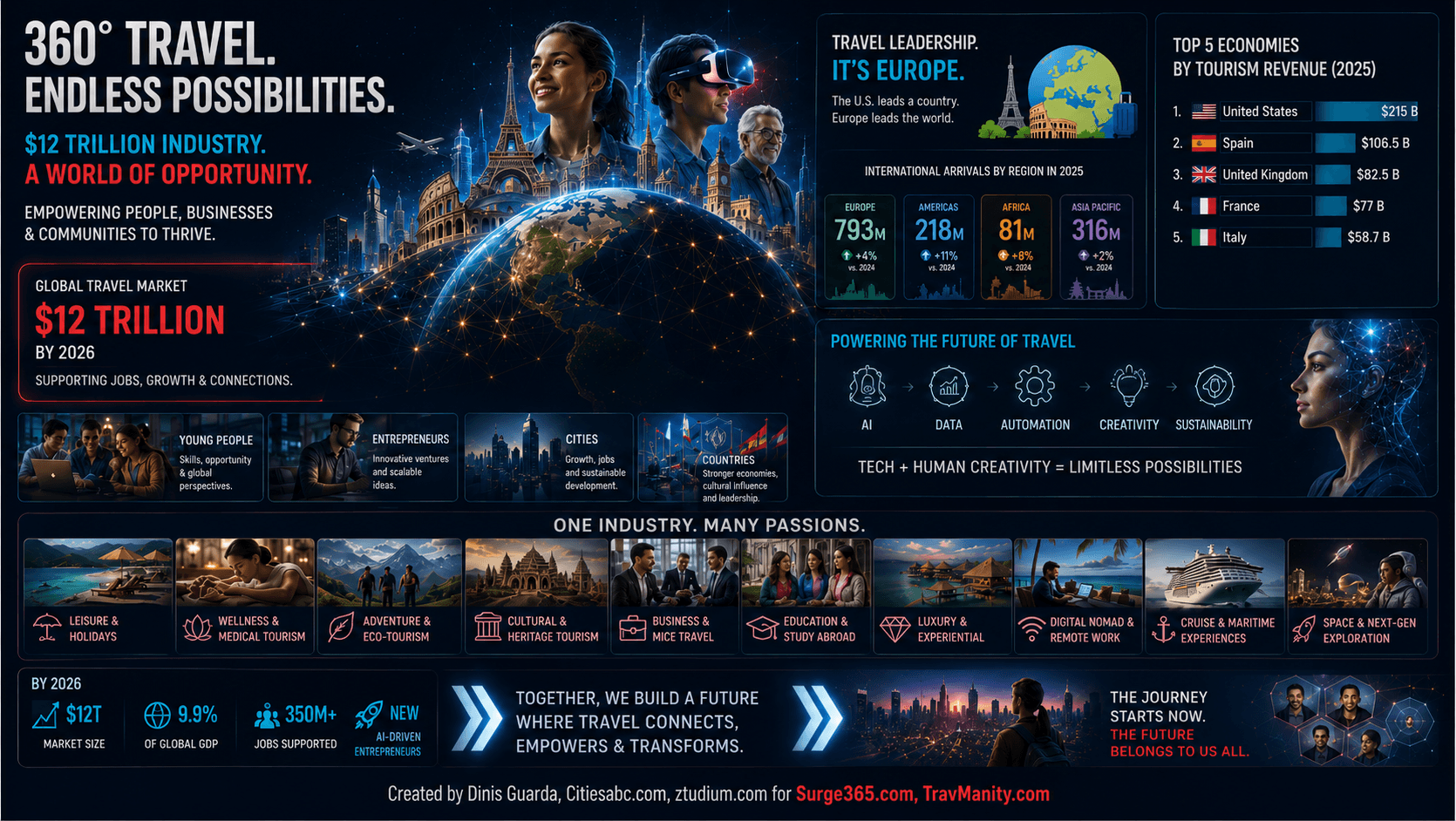
A new wave of AI-powered entrepreneurs is emerging across every segment of the industry, from leisure travel, wellness tourism, and eco-adventures to cultural experiences, luxury travel, business events, study abroad programmes, digital nomad lifestyles, cruise experiences, and even the frontier of space tourism and next-generation exploration.
This is an ecosystem that today empowers entrepreneurs, young people, cities and countries alike: young people gain opportunity, skills and global perspectives; entrepreneurs find new markets and scalable ventures; cities capture economic growth, jobs and sustainable development; and countries build stronger economies, cultural influence and global leadership.
Europe leads this global picture as a continent, even as the United States leads as a single country.
International Tourist Arrivals by Region (2025)
Region | Arrivals (2025) | Change vs. 2024 |
| Europe | 793 million | +4% |
| Asia Pacific | 316 million | +2% |
| Americas | 218 million | +1% |
| Africa | 81 million | +8% |
Top 10 Economies by International Tourism Revenue (2025)
Rank | Country | Revenue |
| 1 | United States | $215 B |
| 2 | Spain | $106.5 B |
| 3 | United Kingdom | $82.5 B |
| 4 | France | $77 B |
| 5 | Italy | $58.7 B |
| 6 | UAE | $57 B |
| 7 | Turkey | $56 B |
| 8 | Japan | $54.7 B |
| 9 | Australia | $52 B |
| 10 | Thailand | $42.7 B |
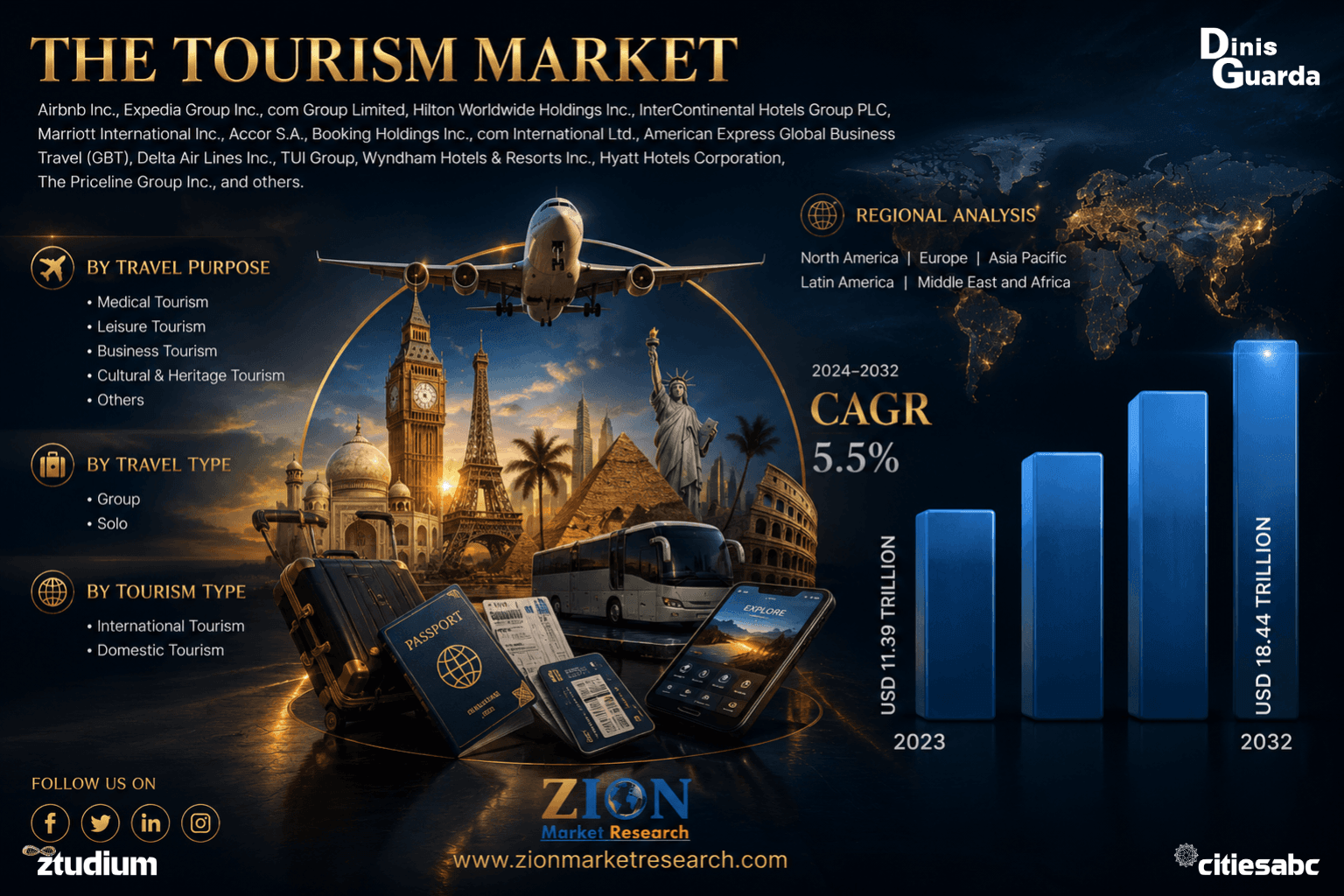
The Quantified Landscape: Macroeconomic Data and Global Projections
The scale of the sector is best understood through its long arc. Analysis from BCG and Tourism Economics traces global leisure travel spending from USD 1.77 trillion in 2000 to USD 4.18 trillion in 2019, and onward to USD 5.21 trillion in 2024 — with projections reaching USD 15.2 trillion by 2040. WTTC, measuring total economic contribution including indirect and induced effects, places 2025 at a record USD 11.6–11.7 trillion and forecasts USD 16.5 trillion by 2035, equivalent to 11.5 per cent of global GDP and more than 460 million jobs.
Within these headline figures sits a frequently overlooked truth. While international and long-haul travel dominate the headlines and the imagination, domestic travel forms the bedrock of the industry, consistently commanding over 75 per cent of total market value. In 2025, domestic visitors spent USD 5.63 trillion, compared with USD 2.02 trillion by international visitors. The historical compound annual growth rate (CAGR) for leisure spending was 4.5–4.8 per cent between 2010 and 2024; projections for the 2024–2040 period anticipate an acceleration to 6.8–8.0 per cent, propelled by rising disposable incomes in emerging markets and the structural shift toward experiential living.
Geographically, value remains concentrated in a handful of mature, high-yield markets. UN Tourism data for 2025 ranks international tourism revenue as follows:
| Rank | Country / Market | Int'l Tourism Revenue (2025) | Core Driver |
|---|---|---|---|
| 1 | United States | USD 215.0 billion | High-value business hubs and extensive premium leisure infrastructure |
| 2 | Spain | USD 106.5 billion | Cultural legacy and dominant Mediterranean sun-and-beach resorts |
| 3 | United Kingdom | USD 82.5 billion | Global financial hub, historic heritage and luxury retail appeal |
| 4 | France | USD 77.0 billion | World-class cultural heritage, gastronomy and luxury sectors |
| 5 | Italy | USD 56.7 billion | Unrivalled density of UNESCO heritage sites and boutique wellness travel |
Behind these leaders, the flow of humanity is vast: UN Tourism and WTTC recorded roughly 1.54 billion international overnight arrivals in 2025, the equivalent of 4.2 million people crossing a border every single day. Europe alone drew some 793 million international arrivals, followed by Asia-Pacific at 316 million, the Americas at 218 million, and Africa at 81 million, the latter representing one of the fastest-growing frontiers on the map.
The Twentieth-Century Genesis of Mass Tourism
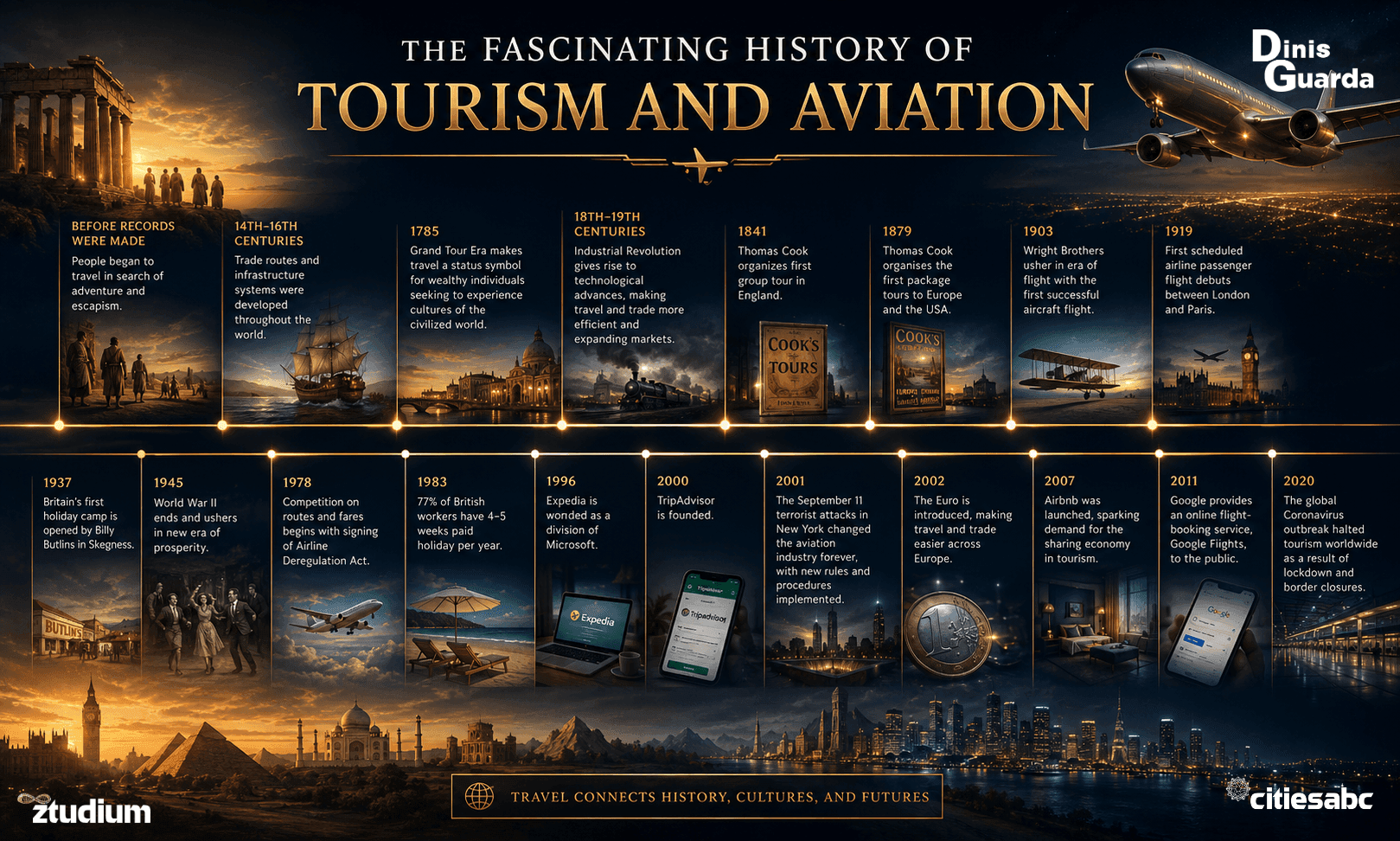
The Long Arc: From Pilgrimage to Platform
It is worth pausing on a fact that is easy to forget: leisure travel, as a structured and globally accessible phenomenon, is essentially an invention of the twentieth century. For the overwhelming majority of human history, movement was a necessity, not a choice. People migrated to survive, marched to conquer, traded to live, and walked to worship. The traveller as a figure of curiosity and pleasure, the tourist, is a modern creation.
That story, however, begins long before the twentieth century and in fact, far longer than most modern commercial sectors can claim. What began as a survival behaviour, early humans moving in search of food, water, and safety, has, over several millennia, transformed into a trillion-dollar global industry that touches nearly every other sector of the economy, from transportation and hospitality to finance, technology, and real estate.
Before Tourism: Survival, Trade, and Empire
Human movement predates any concept of "tourism" by tens of thousands of years. Early Homo sapiens migrated out of Africa roughly 60,000 years ago, driven by climate shifts and the search for fertile land and game, not leisure. This pattern held through the Agricultural Revolution around 10,000 BCE, when settlement gave rise to villages, trade routes, and the first organised infrastructure for moving goods and people.
It was the ancient empires that built the first real travel networks. The Achaemenid Persian Empire, under Cyrus the Great and Darius I, constructed an extensive system of royal roads connecting Susa to Sardis, engineered for administration, the military, and trade, but inadvertently laying the groundwork for cross-regional movement of people and ideas. The Silk Road, which Persia helped sustain for centuries, became history's first transcontinental connective tissue, linking China, Central Asia, the Middle East, and the Mediterranean.
Ancient Greece and Rome: The First Leisure Travellers
Leisure travel, movement undertaken for its own sake rather than necessity, first emerges clearly in Greco-Roman antiquity. Wealthy Greek citizens travelled to Olympia, Delphi, and the Oracle of Apollo at Delos, framing travel as part of intellectual and civic education. Rome extended this further, with elites visiting Baiae, a seaside resort, and Pompeii's thermal baths, while Rome itself became a destination for visitors from across the Mediterranean drawn by its architecture and public spectacles.
This period introduced two structural features that still define the industry today: travel as a status good reserved for the wealthy and travel as a service economy, the earliest resorts, spas, and hospitality venues emerged specifically to serve travelling elites.
The Middle Ages: Faith as the First Mass-Market Driver
If antiquity proved that people would travel for culture, the medieval period proved they would travel in large numbers for faith. Islamic, Judaic, and Christian traditions all encouraged pilgrimage, and routes to Mecca, Jerusalem, Rome, and Santiago de Compostela became the first genuinely cross-class travel phenomenon – pilgrims ranged from aristocrats to peasants, travelling in organised groups despite poor roads, banditry, and disease risk.
Crucially, pilgrimage created the first real tourism infrastructure: hostels, inns, and hospitals built specifically to support traveller flow, alongside religious architecture such as cathedrals and shrines that became destinations in their own right. The Islamic Golden Age, from the eighth to the fourteenth century, simultaneously expanded Silk Road trade and travel, with Persia remaining a key crossroad between East and West.
The Grand Tour: Tourism's First Defined Product
By the 1660s, the Grand Tour had become an established institution among the European aristocracy: a structured, multi-month circuit through France, Switzerland, Italy, Germany, and the Netherlands, undertaken by young elite men accompanied by tutors as a capstone to their education. Unlike pilgrimage or ancient leisure travel, the Grand Tour had a defined itinerary, a target demographic, and a recognisable value proposition rooted in cultural credentialing — in effect, the first packaged product in travel, centuries before anyone formalised the model commercially.
By 1785, the Grand Tour era had made travel a status symbol for wealthy individuals seeking to experience the cultures of the civilised world, the first glimpse of travel as pleasure rather than pure necessity, though still the exclusive preserve of the privileged few.
The Birth of Commercial Mass Tourism
The eighteenth and nineteenth centuries brought the Industrial Revolution, which gave rise to technological advances that made travel and trade more efficient and expanded markets.
The single most important inflection point in tourism history arrived in 1841, when Thomas Cook organised the first group tour in England, a fixed-price excursion from Leicester to Loughborough that bundled transportation, accommodation, and activities into a single offering. This innovation coincided with the build-out of Europe's railway network, and the combination proved transformative: falling rail fares plus a fixed-price, fully arranged travel product made long-distance leisure travel accessible to the middle class for the first time.
Cook went further in 1879, organising the first package tours to Europe and the USA, extending the structured travel experience across borders for the first time. His company, Thomas Cook & Son, scaled this model domestically and internationally, effectively inventing the modern travel agency and tour-operator category. The nineteenth century also saw the emergence of adjacent categories that remain core market segments today: health and spa tourism, coastal resort tourism, and early amusement-park tourism.
The Twentieth Century: Aviation and the Industrialisation of Travel
Then came the breakthroughs that would define the century to follow. In 1903, the Wright Brothers ushered in the era of flight with the first successful aircraft flight. By 1919, the first scheduled airline passenger flight debuted between London and Paris – aviation had moved from experiment to service.
If rail had democratised travel within continents, aviation would democratise it across them.
That creation of modern mass tourism was made possible by a convergence of forces. The institutionalisation of the weekend and the paid holiday handed ordinary workers something previously reserved for aristocrats: time. Britain's first holiday camp, opened by Billy Butlins in Skegness in 1937, captured this shift directly, making organised leisure accessible to the working class for the first time.
World War II ended in 1945, ushering in a new era of prosperity that would accelerate this trend further. By 1978, competition on routes and fares began with the signing of the Airline Deregulation Act, and by 1983, 77 per cent of British workers had four to five weeks of paid holiday per year, a remarkable transformation from a world in which leisure time barely existed for the average worker.
The rise of a broad middle class across Western and, later, Asian economies handed people the means. And the great structural shift from a nineteenth-century industrial order to a twentieth-century service and leisure economy handed them a culture in which experience itself became a marker of status.
Technology supplied the wings. The arrival of commercial jet aviation, above all the Boeing 747 in the late 1960s, collapsed the cost and time of transoceanic travel and democratised the long-haul journey. On the ground, the post-war expansion of motorways and high-speed rail rewired domestic mobility.
The Digital Era: A Second Revolution Layered on the First
- 1996 — Expedia is founded as a division of Microsoft
- 2000 — TripAdvisor is founded
- 2001 — The September 11 terrorist attacks change the aviation industry forever, with new rules and procedures implemented
- 2002 — The Euro is introduced, making travel and trade easier across Europe
- 2007 — Airbnb launches, sparking demand for the sharing economy in tourism
- 2011 — Google provides an online flight-booking service, Google Flights, to the public
- 2020 — The global coronavirus outbreak halts tourism worldwide as a result of lockdowns and border closures
The Present Era
The data underscores how completely the industry has transformed since Cook's era. International tourism receipts reached a record USD 1.734 trillion in 2024, with the sector contributing USD 10.9 trillion to global GDP — roughly 10 per cent of world output — and supporting 357 million jobs, or one in ten jobs globally. An estimated 1.52 billion international tourists travelled in 2025 alone, nearly 60 million more than the prior year, with most destinations worldwide posting solid growth.
The consequence of this long arc, from pre-recorded history's first wanderers, to Persian royal roads, to pilgrim routes, to Cook's package tours, to the jet age, to the smartphone-booked holiday, was a quiet revolution in human identity.
For the first time, individuals began to define their wealth not only by what they owned but by where they had been and what they had felt. The experiential portfolio was born, and with it, the foundations of a USD 12 trillion industry — one now standing at the threshold of an AI abundance economy, where AI intelligence, data insights, automation efficiency, creativity experiences, sustainability impact, and shared prosperity growth combine under a simple equation: AI plus human creativity equals limitless possibilities.
I have undertaken a deep dive into the innuendo of the travel and tourism industry as we enter a new phase of growth in this sector and how this affects all of our cities, countries, and daily lives. Drawing on data from Tourism Economics, the Boston Consulting Group (BCG), Future Market Insights (FMI), UN Tourism, Skift, IATA and Virtuoso, it maps the sector across eleven dimensions, from its twentieth-century genesis to its sustainable, faith-driven, athletic, and luxury frontiers.
Above all, this research and visual paper argues that travel occupies a singular position in the next evolutionary stage of humans as humanity reaches 9 billion people in 2050. As we delve into the challenges and opportunities of the perplex emerging AI and AGI abundance economy. As artificial intelligence redesigns cognitive and administrative labour across every white-collar profession, society is shifting from an economy of production to an economy of experience. In that transition, hospitality, curation, and human presence are not casualties of automation — they are its counterweight.
This thesis was set out in my Citiesabc analysis, "AI AGI Bulletproof Jobs Sectors for Humanity 2030–2050," and travel is its clearest proof. When intelligence becomes abundant, what becomes scarce is taste, trust, lived experience and emotional resonance. Travel is the industry built on precisely those things.
Sources:
- World Travel and Tourism Council (WTTC) and Chase Travel — Economic Impact Research (EIR), 2025–2026.
- UN Tourism (UNWTO) — World Tourism Barometer, May 2025.
- GeoData & Rankings — international tourism revenue and arrivals data visualisation, 2025.
- Tourism Economics and Boston Consulting Group (BCG) — Global Leisure Travel Spend and Long-Term Horizon Tracking (2000–2040 analysis).
- Future Market Insights (FMI) — Sustainable Tourism Market Size, Share and Regional Growth Vectors (2026–2036).
- Skift, IATA and Virtuoso — Premium and Luxury Insights (2024–2026).
- Dinis Guarda — "AI AGI Bulletproof Jobs Sectors for Humanity 2030–2050," CitiesABC (12 June 2026): https://citiesabc.com/ai-agi-bulletproof-jobs-sectors-for-humanity-2030-2050
- "The Fascinating History of Tourism and Aviation" — historical timeline of tourism and aviation milestones.
- "360 Lifestyle Travel, Experiences & Creative Identity" — created by Dinis Guarda, CitiesABC.com, Ztudium.com for Surge365.com and TravManity.com.
Share

Dinis Guarda
Dinis Guarda is an author, entrepreneur, founder CEO of ztudium, Businessabc, citiesabc.com and Wisdomia.ai. Dinis is an AI leader, researcher and creator who has been building proprietary solutions based on technologies like digital twins, 3D, spatial computing, AR/VR/MR. Dinis is also an author of multiple books, including "4IR AI Blockchain Fintech IoT Reinventing a Nation" and others. Dinis has been collaborating with the likes of UN / UNITAR, UNESCO, European Space Agency, IBM, Siemens, Mastercard, and governments like USAID, and Malaysia Government to mention a few. He has been a guest lecturer at business schools such as Copenhagen Business School. Dinis is ranked as one of the most influential people and thought leaders in Thinkers360 / Rise Global’s The Artificial Intelligence Power 100, Top 10 Thought leaders in AI, smart cities, metaverse, blockchain, fintech.


